How to See Your Exact Google Maps Rank Without Paying for Bloated Tools
If you are standing in your storefront, pulling out your iPhone, and searching for your primary service only to see your business at the top of the Map Pack, I have some bad news for you: you’re looking at a lie. Tracking your google maps rank tracker results manually from your own office is the most common mistake small business owners make. It leads to a false sense of security and, eventually, a phone that stops ringing. Google knows exactly where you are, and it is biased toward showing you your own business because of your physical proximity and search history.
As a Local SEO Consultant and Google Business Profile Product Expert, I see this “Proximity Trap” daily. To truly understand how your customers see you, you need to step outside your own bubble. You need to see how you rank three miles to the North, five miles to the West, and in the neighboring suburb where your biggest competitor is eating your lunch. But here is the catch: you don’t need to spend $200 a month on “enterprise-grade” SEO suites to do it. In this guide, I’m going to show you how to get precise, street-level data using lightweight local seo tools and strategies that respect your budget.
The “Proximity Trap” and the Three Pillars of Local Rank
Google’s local algorithm is built on three primary pillars: Proximity, Relevance, and Prominence. While you can control relevance (through google business profile seo) and prominence (through reviews and links), proximity is the “silent killer” of rankings. In dense urban environments, Google Maps results can change every 0.5 to 1.0 miles. If you are a plumber in a major metro area, being #1 at your warehouse doesn’t mean you are even in the top 20 at the high-end housing development ten minutes away.
Personalization bias is the second layer of the trap. Google’s goal is to provide the most “helpful” result. If you frequently visit your own dashboard or website, Google’s AI assumes you have a high affinity for that business. Consequently, it will artificially inflate your ranking in your personal search results. To get the truth, you must bypass your own identity and location. You need to see the “raw” local map pack seo data that a cold prospect sees.
Why “Bloated” Tools Are Killing Your Budget
Many business owners gravitate toward massive SEO platforms like Ahrefs or Semrush because they are household names in the digital marketing world. However, these tools were built for global, organic search – not the hyper-local nuances of the Map Pack. They often track “organic” rank (the blue links below the maps), which has a completely different set of ranking factors than the Google Business Profile (GBP).
Paying for these bloated suites is often overkill for a local service business. These tools lack the granularity of geo-grids and often provide “average” rankings across a whole city, which is a vanity metric that doesn’t help you book more jobs. You need to track local success without getting distracted by vanity metrics. Instead of a single “Rank #3” number, you need a visual map of where your visibility starts and where it drops off – a phenomenon known as “ranking bleed.”
The Geo-Grid: The Only Map Rank Data That Matters
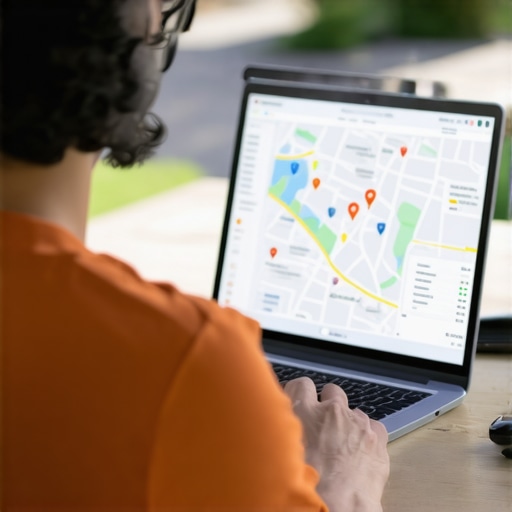
If you want to see the truth, you need a geo-grid. A geo-grid is a visual heatmap that overlays a grid of points across a map. At each point, a specialized google maps rank tracker simulates a search and records your position. This creates a “weather map” of your SEO health. Green circles (Ranks 1-3) mean you are winning; red circles (Rank 4+) mean you are invisible to the majority of users.
The industry standard for a comprehensive view is a 49-point grid (7×7) or a 100-point grid. This allows you to see exactly where your “ranking radius” ends. For example, you might find that you dominate the North side of town but disappear the moment a user crosses a specific highway. This data is actionable. If you know you disappear in a specific zip code, you can tailor your GBP posts and photos to mention landmarks in that area to increase relevance.
While some high-end tools charge a fortune for this, you can find lightweight versions. Tools like Localo or Merchynt offer limited free versions of these heatmaps. For those who want more control without the monthly subscription bloat, looking into a dedicated google maps rank tracker like SEO Viper can provide the specific data points needed to move the needle without the fluff of a national SEO tool.
3 Lightweight Methods to Check Rank for Free
You don’t always need a heatmap to get a quick pulse check. Here are three manual, lightweight ways to see your rank in google map pack without spending a dime.
Method 1: Browser Extensions (GMB Everywhere & Local Rank Guru)
Browser extensions are the “secret weapon” of local SEO consultants. Tools like GMB Everywhere or Local Rank Guru overlay data directly onto the Google Maps interface. When you perform a search, these extensions can show you the categories your competitors are using, their review velocity, and even a basic “Teleport” feature to see how rankings change from different spots. This is essential for a quick google business profile audit tool experience without leaving your browser.
Method 2: GS Location Changer (The Pro’s Choice)
This is the most accurate manual method available. GS Location Changer is a Chrome extension that allows you to “spoof” your GPS coordinates. You can drop a pin on a specific street corner five miles away, and Google will treat your browser as if you are physically standing there.
- Install the extension and enter the specific latitude and longitude or address you want to test.
- Open an Incognito window.
- Search for your primary keyword (e.g., “emergency dentist”).
This gives you a 100% accurate view of what a customer at that exact location sees, bypassing all personalization bias.
Method 3: Incognito + Zip Code (The Old School Way)
If you don’t want to install extensions, use the “Zip Code” method. Open an Incognito window, go to Google, and search “[Keyword] [Zip Code].” While less precise than GPS spoofing (since zip codes cover large areas), it’s a fast way to see if you are even in the conversation in surrounding areas. It is a fundamental step in any rank google business profile strategy.
Analyzing the “Why” Behind Your Rank
Once you’ve used a local seo tools suite to identify that you are Rank #8 in a key neighborhood, the next question is: *Why?* Tracking is useless without optimization. You need to look at the businesses ranking in the top 3 and compare your “infrastructure” to theirs.
As Rashid Rehman famously said, “Local SEO isn’t marketing. It’s infrastructure.” This means your rankings are a reflection of how well you’ve built your digital foundation. Start by following these 7 local audit steps that actually bring more calls to your Colorado shop. Check your primary and secondary categories – are you using “Plumber” when your top competitor is using “Heating Contractor”? Check your review velocity; if the top 3 are getting 5 reviews a week and you’re getting one a month, you will never bridge the gap.
Furthermore, you need to spot exactly why your Aurora competitors outrank you on maps. Often, it’s not about “magic” SEO; it’s about NAP (Name, Address, Phone) consistency across the web and the quality of the photos you upload to your profile. Google rewards active, accurate profiles that provide a great user experience.
Local SEO in 2026: Beyond Simple Tracking
The landscape of local search is shifting. We are moving toward a world of AI Overviews (SGE) and highly interactive maps. To rank higher on google maps in the coming years, you have to move beyond just keywords. Google’s AI is now looking for “real-world signals.” This includes the metadata in your photos, the sentiment in your reviews, and even the frequency of “Check-ins” or mentions of your business on local community sites.
To stay ahead, you must ditch the AI spam and use real local SEO Colorado tactics for 2026. This means stop using AI to write generic gmb ranking service posts. Instead, upload real photos of your team on the job, respond to reviews with helpful information (not just “Thanks!”), and ensure your “Services” menu is fully built out with unique descriptions. In 2026, “Infrastructure” beats “Optimization” every single time.
Conclusion & Your Action Plan
Stop flying blind. If you aren’t tracking your rankings across a geo-grid, you don’t actually know how your business is performing. You are likely missing out on 70% of your potential service area because you are only visible within a mile of your front door.
Your action plan is simple:
- Stop searching for yourself on your own phone.
- Use a lightweight google maps rank tracker or the GS Location Changer method to see your real ranking radius.
- Identify the “red zones” where your ranking drops off.
- Perform a google business profile optimization audit focused on those specific neighborhoods.
If you want to bypass the learning curve and get a professional-grade gmb seo tools experience, I recommend checking out a specialized google maps ranking service. Don’t pay for the bloat of a national tool when you only need to win in your own backyard. Track your data, fix your infrastructure, and start answering the phone more often.